- Warnings are used to ensure safety, to prevent damage to equipment and breaches of security and to ensure the law is not broken. The simplest warnings are basic instructions NOT to do something: Don't do X / No + -ing / Avoid +-ing / Never do X
- Sometimes the warning is twinned with matching good practice: Always do X, never do Y / Do X rather than Y
- Warnings may be made stronger by using must/mustn't and in some cases should/shouldn't. (Do this exercise to see the difference)
- If there's any reason to fear the warning may not be understood, a reason for the warning may be added: Never use a screwdriver to extract ICs, the pins are very fragile
-
EXERCISE: Rewrite
each of these warnings and give a reason where appropriate:
- Don't give open access to PCs (avoid)Avoid giving open access to PC because you can be hacked/ you may get viruses.- You must not use your own programs on these machines (never)Never use your own programs because you may introduce viruses.- No coffee in this lab (must not)You must not drink coffee in this lab because the keyboards can get wet/be damaged.- Avoid giving financial information in a chat room (don't)Don’t give financial information in a chat room because you can be cheated/phished.- Never give out your password (always)Always protect your password because it is important for your private life- Don't use out-of-date antivirus software (use)Use up to date antivirus software to protect your PC- Never use a computer that has been standing for a long time in a cold environment without waiting until it has reached normal room temperature (always)Always wait until your computer has reached normal room temperature before using it or you may damage the hard disk.- Cards must not be removed from their anti-static packing until required (never)Never remove cards from their anti static packing because you can damage them.- Use an IC extraction tool, don't use a screwdriver (rather than)Use an IC extraction tool rather than a screwdriver.You must not work on a power-connected computer because you can get shocked/electrocuted. - You can find an interesting explanation on modals and do some exercises HERE.
- Download Modal Verbs worksheet HERE.

Big Ben and the English Parliament (London)
Wednesday, January 8, 2014
Warnings.

Monday, December 16, 2013
Household Chores.
- What are some ideas on how to assign household chores in a family? Should parents give money to their children as a reward?
- Listen to the conversation and answer the questions. Press the "Final Score" button to check your quiz.

- Listen to the conversation again as you read the Quiz Script.
Wednesday, December 4, 2013
Functions.
As we saw in class, we have different ways to describe functions in English:
 Here you have some examples:
- ROM holds intructions which are needed to start up the computer.
- ROM is used to hold /is used for holding instructions which are needed to start up the computer.
- The function of ROM is to hold instructions which are needed to start up the computer.
- A scanner is used for inputting text and graphics.
- A printer is used to print out data from a computer.
- An ATM (automated teller machine) provides cash and account information to bank customers on account of a swipe card.
- A PDA is used to store information such as appointments.
- The function of a hard disk drive is to store programs and data.
- A supercomputer is used to process quickly very large amounts of information, for example in a government department or a university.
- A mainframe computer is used for processing large amounts of data such as a major company's accounts and client database.
- Barcodes provide computer-readable information on a product so that it can be identified and priced automatically.
- Swipe cards are used to provide a secure means of identifying authorised users of many different facilities such as banks, libraries and computer labs.
- The function of memory is to hold the instructions and data used by the processor.
Tuesday, December 3, 2013
Prepositions of Place.
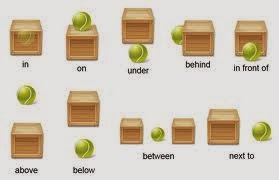
Digital Cameras - A Listening.
- Listen to PART 1 of a discussion about digital and conventional cameras and find the similarities and differences between them.
- Now listen to PART 2 and list the disadvantages of digital cameras.

- And if you need it, read the LISTENING SCRIPT.
Saturday, November 23, 2013
Countable and Uncountable Nouns in English.

(source: English Is Fun/Facebook)
- Countable Nouns are used in singular and plural forms.
- Uncountable Nouns are ONLY used in singular forms.
- A/an, many and a few are used with countable nouns; much and a little with uncountable nouns.
- The, some and any are used with both countable and uncountable nouns, but you will find some only in affirmative sentences.
- You can do some online exercises HERE.
- And you can see an interesting PowerPoint presentation HERE.
Wednesday, November 20, 2013
Grammar Tips - Relative Clauses & Passives

RELATIVE CLAUSES
- We use Relative Clauses to join two sentences, and to give additional information about something:
- George ate the apple which was lying on the table.
- By combining sentences with a relative clause your text becomes more fluent and you avoid repeating certain words.
- If you want a more detailed explanation, click HERE.
- If you need more practice you can do some online EXERCISES.
PASSIVES
- The Passive voice is used when the focus is on the ACTION, it's not important who or what is performing it.
- The road is being repaired.
Subscribe to:
Posts (Atom)